

By Chidimma Okwara,
In a significant move aimed at boosting industrial growth and easing the high cost of production, the Nigeria Customs Service (NCS) and the Manufacturers Association of Nigeria (MAN) have reached a definitive agreement on strategic exemptions from the controversial 4% Free-on-Board (FoB) levy on imports.
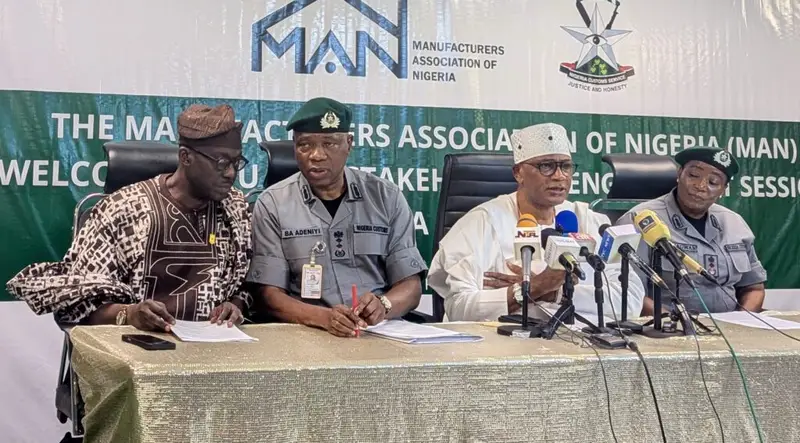
The decision, which followed high-level consultations between the Comptroller-General of Customs, Adewale Adeniyi, and the President of MAN, Francis Meshioye, demonstrates a commitment to balancing the nation’s revenue generation mandate with the imperative of strengthening the productive sectors of the economy.
The central point of the agreement is the approval for the exemption of critical strategic imports from the payment of the 4% FoB levy. This relief is expected to significantly reduce manufacturers’ operating costs, which have been a major factor in the country’s rising inflation.
SEE ALSO:
The exemptions, which followed consultations with the Minister of Finance and Coordinating Minister of the Economy, include:
-
- Imports of raw materials, spare parts, and machines by manufacturers who are already beneficiaries of concessions contained in Chapters 98 and 99 of the Customs Tariff. These chapters are typically reserved for goods granted special import conditions due to their critical role in industrial production.
- Imports of spare parts for commercial airlines have also been exempted, a measure designed to support the stability and growth of the aviation sector.
- Goods imported for humanitarian, life-saving, and other related purposes are also exempted.
- Goods imported for government projects that have valid Import Duty Exemption Certificates (IDEC) are covered by the exemption.
- Beneficiaries of the Presidential Initiative aimed at unlocking Nigeria’s healthcare value chains will also enjoy the exemption.
Fast-Track Onboarding for Unlisted Manufacturers: Recognizing that many MAN members importing essential inputs are not currently listed under Chapters 98 and 99, the agreement includes a vital provision for their inclusion.
MAN, the NCS, and the Federal Ministry of Finance will immediately begin a tripartite consultation to work out modalities for the expedited onboarding of these manufacturers onto the special tariff chapters.
Manufacturers who have already paid the 4% FoB levy but are awaiting onboarding will have the payments held as a credit to be utilized for future customs-related transactions once their inclusion on Chapters 98 and 99 is finalised.
Broader Trade Facilitation Initiatives: Beyond the levy exemptions, the communique also outlined a series of broader trade facilitation measures the NCS is committed to implementing to further support the manufacturing sector:
-
- Development of a streamlined framework to reduce bureaucratic bottlenecks and streamline regulatory processes.
- Systematic reduction of unnecessary checkpoints that add costs and delays without significant value.
- Implementation of digital solutions to accelerate trade processing, enhance real-time clearance capabilities, and improve the Automated Risk Assessment system for compliant traders.
- The NCS committed to providing clearer guidelines for the AEO scheme, which grants compliant traders special clearance privileges.
- Establishment of a framework for regular policy dialogue, proactive engagement on customs changes, and a real-time feedback system to assess the impact of policies on the manufacturing sector.
A Win for Industrial Competitiveness: The agreement has been widely hailed as a critical step toward reducing the cost of doing business in Nigeria and improving the industrial sector’s global competitiveness. The President of MAN, Otunba Francis Meshioye, noted that exempting raw materials and machinery from the levy would help reduce production costs, which should ultimately translate to lower prices of goods and services for the final consumer and a contribution to curbing inflation.
The collaborative approach demonstrated by the Customs Service and MAN is seen as a template for resolving conflicts between revenue-generating government agencies and the productive sectors of the economy, promising a more stable and predictable operating environment for manufacturers.