TheLeadWay Reports,
Chinese supporters hold South Korean and China’s flags in Busan.
“Both sides achieved something, but they came into this with different leverage,” says Jason Bedford, an investment analyst who follows the Chinese economy closely.
I was watching the body language on the screen during the meeting – and it was very different between President Xi and President Trump.
Xi stayed very professional, and said what he had prepared. Whereas Trump was very much more ad lib.
It was all carefully choreographed.
At the end of the meeting, Xi’s car was waiting outside – so it looked like Trump had to usher him to his car, where his team was waiting.
I was outside with the Chinese supporters – it seemed the embassy had organised some flag waving.
READ ALSO
They were telling each flag bearer when to wave their flags when the Chinese president passed.
That gives you an idea of the two different styles here.
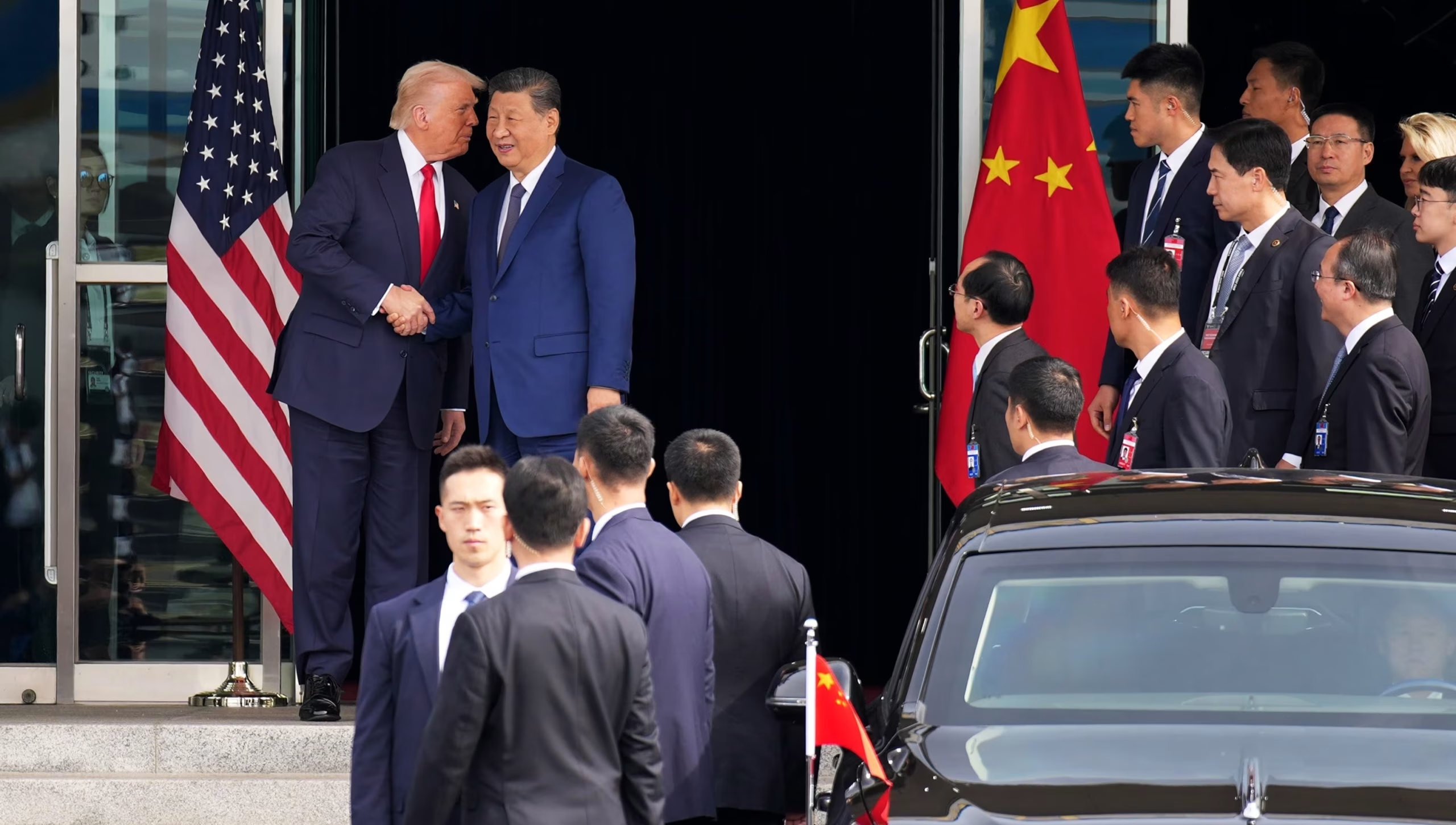
The moment Trump and Xi shake hands
As we mentioned earlier, this is their first face-to-face meeting in six years.
Moment Donald Trump and Xi Jinping shake hands.
‘There is enormous respect between our two countries’ – Trump published on his social media platform, Truth Social.
“Our farmers will be very happy!” he says. The US president says China will start buying “massive” amounts of soybeans, sorghum and other farm products, as well as American energy from Alaska.
He also says China has “agreed to continue” the flow of rare earth materials and that “they will help us end the Fentanyl Crisis.”
“There is enormous respect between our two Countries,” Trump says.
Just a reminder, China has not confirmed some of the measures mentioned by the US president – here’s what the Chinese commerce ministry announced earlier
“Tariff reduced and export control eased”. All eyes are on the results of that meeting, which lasted more than 1.5 hours.
Washington will reduce some tariffs on Chinese goods – a relief for businesses caught in the US and China’s tit-for-tat trade war
China’s export controls over rare earths are among the biggest sore spots in bilateral tensions – Trump said the meeting with Xi has “settled” the rare earths issue; Beijing later announced a suspension of its “implementation of relevant export control measures”
Beijing will also be speaking to Nvidia CEO Jensen Huang, according to Trump – Nvidia is at the heart of their fight over AI chips: China wants high-end chips but the US wants to limit China’s access, citing national security.
Speaking to reporters after, Trump said it was an “amazing meeting”
Xi says both sides have reached a consensus to resolve “major trade issues”, Chinese state media reported.
Trump and Xi shake hands and smile for the cameras. They’re both wearing navy suits and standing in front of alternating US and China flags
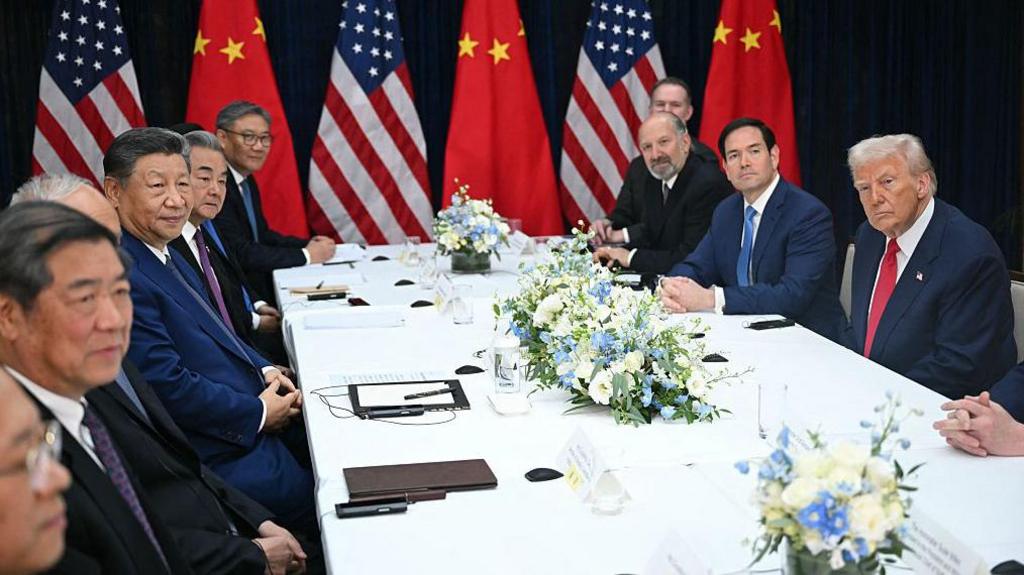
Officials site at long rectangular table – US officials sit on the far side and Chinese officials sit on the near side. At one end of the table flies alternating US and Chinese flags
US and Chinese officials joined the trade talks – including US Secretary of State Marco Rubio and Treasury Secretary Scott Bessent, as well as Chinese Foreign Minister Wang Yi
Talks lasted for an hour and 40 minutes, Chinese broadcaster CCTV said – longer than scheduled
Shortly afterwards, Trump left on Air Force One – once aboard he told reporters that the issue of rare earths is “settled” and that the US will reduce tariffs on all Chinese goods, effective immediately.
Henry Wang, a former adviser to China’s State Council, tells BBC Radio 4’s Today programme that Trump and Xi’s talks “went very well”.
He says Trump has “adopted a more pragmatic approach” this time.
There have been several trade talks between the two leaders, and now we’re seeing that a “framework and structure has been laid”, he adds.
Based on what we know so far, it also seems Beijing will be able to buy advanced computer chips from the US – although not Nvidia’s Blackwell chip, which is said to be the company’s best for AI.
Wang describes this as a “good start” and further evidence of the US taking a pragmatic stance.
The US has finally realised it is “counterproductive” to restrict China, Wang says.
We’ve just got more details from China’s commerce ministry on what Xi Jinping and Donald Trump have agreed.
China will suspend its “implementation of relevant export control measures” for a year, the ministry says. Earlier this month, Beijing tightened controls on rare earths and other trade materials critical for advanced tech manufacturing.
In exchange, Washington will suspend for a year a rule aimed at widening trade restrictions to entities that are at least 50% owned by entities on a “sanctions list” – we’ll explain more about this later.
The ministry also says Washington has agreed to reduce tariffs on all Chinese goods enacted earlier in response to the flow of chemical ingredients for fentanyl into the US. Other reciprocal tariffs on Chinese goods will remain suspended for a year. Trump has also made a similar announcement earlier.
The US will suspend for one year the implementation of its measures against China’s maritime, logistics and shipbuilding industries, the ministry also says. China will also suspend its countermeasures against the US for the same period.
Trade deals normally take years to negotiate, and countries around the world have been thrown into resolving differences with the current Trump administration within a matter of months.
So, it’s no surprise that Xi Jinping and Donald Trump didn’t sign on the dotted line before the US president left South Korea.
Officials will still be bashing out final details but agreement on the supply of rare earths is a significant one.
An agreement on soybeans is a win for Trump – US farmers have been losing billions of dollars in sales of the crop to China over the trade frictions, after they largely supported Trump in his campaigns for president.
China is the world’s biggest manufacturing nation.
It often produces goods below the true cost of production – due to state-backed financial support.
If products can’t enter the US, Chinese firms could look to sell them cheaply abroad.
While this could benefit some consumers, it could also undercut manufacturers in other countries.
For example, the lobby group UK Steel has previously warned about the risk of excess steel being redirected to the UK market.
Some specific industries will also be hopeful after today’s announcements.
China plays a central role in refining many vital metals for industry – including about 90% of the world’s rare earths.
US President Donald Trump says after today’s meeting that “there’s no roadblock from China any more” – although it’s unclear what that actually means, as we haven’t yet heard a concrete announcement from China.
As Trump wraps up his much-anticipated Asia trip, here’s a look at what he got up to.
He started in Malaysia, where South East Asian leaders were attending a summit.
Trump presided over the signing of a “peace deal” between Thailand and Cambodia, who have seen long-standing border tensions erupt into open conflict in July.
Next, he travelled to Japan and met newly-elected Prime Minister Sanae Takaichi. The two leaders exchanged warm words and signed two agreements: one to boost rare earths supply and production, and another dubbed a “new golden age” deal, reaffirming earlier trade agreements.
His final stop was South Korea, where he met South Korean leader Lee Jae Myung and spoke at the Apec business leaders summit in Gyeongju.
Before leaving, Trump met Chinese President Xi Jinping at Busan airport. This was their first meeting since Trump’s re-election – and comes amid high bilateral tensions over tariffs, TikTok and rare earths.
The high-stakes meeting lasted more than 1.5 hours. Details are still emerging, but Trump has confirmed lower tariffs on Chinese goods, and a visit to China in April.
One of South Korea’s biggest exports in recent years has been K-beauty. It’s estimated that there are 30,000 brands churning out innovative products at comparatively affordable prices.
It’s already a $10 billion industry not counting exports to the US, Europe and South East Asia where popularity is growing rapidly.
US press secretary Karoline Leavitt posted about her K-beauty haul while in South Korea with Donald Trump.
A screenshot of an Instagram story showing Korean beauty products laid out on a bed
K-beauty retailer Olive Young imposed a 15% duty on all U.S. orders to offset higher costs that came into effect in August.
Seung-Hwan Kim, the CEO of another giant of the industry – Amore Pacific – told me that his company is adjusting after exporting to the US with zero tariffs under a free trade deal between the two countries.
He added that his company, which owns brands like Laniege and CosRX, has had to realign its strategy amid higher costs, but that he is optimistic that demand in the US will remain strong.
China’s state media has now published a readout on Xi Jinping’s comments during the meeting with Trump.
The Chinese leader said both sides had reached a consensus to resolve “major trade issues”. The Chinese and US teams will be working on delivering outcomes that will serve as a “reassuring pill” for both countries’ economies, said Xi.
He pointed out that both countries have “promising prospects” for cooperation in areas such as handling illegal immigrants, cyber fraud, money laundering and artificial intelligence, according to the readout on Xinhua News Agency.
“China and the United States can jointly demonstrate the responsibility befitting of major powers, working together to accomplish more significant, practical and beneficial undertakings for both nations and for the world,” he said.
Here’s a look at how US tariffs on Chinese goods have changed during President Trump’s second term so far.
February: Trump imposes a 10% tariff on Chinese goods due to what he said was the flow of the drug fentanyl to the US.
March: The president adds another 10% tariff on goods from China, accusing it of not doing enough to address the fentanyl flow to the US.
April: Trump adds a 34% levy on all Chinese imports as part of his sweeping “Liberation Day” tariffs. This brings the total to 54% on Chinese goods. This is on top of sector-specific tariffs, which means some Chinese imports are facing far higher tariffs.
May: The US and China reach an agreement to cool trade tensions after weeks of escalating tit-for-tat measures. The two sides agree to roll back tariffs – at this point rates have shot past 100% on both sides – they had each imposed since April.
But the 20% levy the US had originally imposed in February stays – so the Chinese face a 30% tariff.
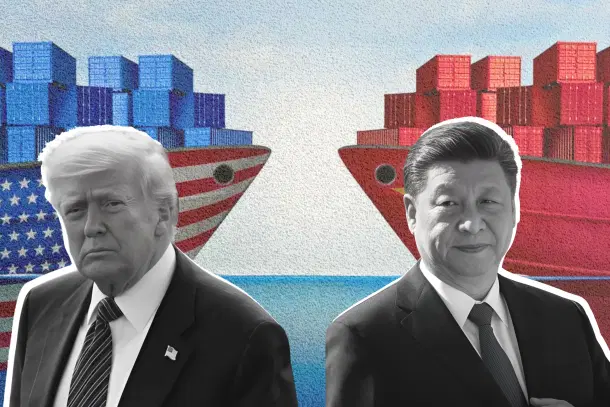
30 October: On Thursday, after talks with Xi Jinping, Trump tells reporters he has agreed to lower the “fentanyl tariff” to 10% from 20%, possibly a reference to the February levies.
But it’s worth remembering that Chinese imports in difference sectors face different tariffs, including some from before Trump took office. And those tariffs on steel, timber and other commodities are still in place.
So, it’s not clear yet how exactly Thursday’s tariff announcement affects various sectors. We will have to wait for more clarity from the White House.
Trump has described his talks with Xi, which spanned more than 1.5 hours, as a “great success”. Here are the key snippets from that meeting:
Today marked the first face-to-face meeting between Donald Trump and Xi Jinping since Trump returned to the White House in January.
Note: President Xi is trying to develop his country’s high tech economy and China is already building more robots than any other country. To continue that development, Chinese companies need access to advanced computer chips made by Nvidia – but the sale of those have been restricted by Washington.
Trump said that Beijing would be speaking to Nvidia’s CEO and that US authorities would serve as a “sort of referee”, although the US president claimed those discussions will not include the Blackwell chip which is said to be Nvidia’s best for AI.
What I will be looking out for is what China has given up. Beijing has used its chokehold over rare earths as key economic leverage. Mr Trump said that there would be “no roadblock” and the trade of rare earth metals had been settled, but there has been no such announcement from the Chinese.
The key thing is to hear China’s side of the discussions and comparing the read outs from both sides. Only when the full details are known then will we get a better idea of the give and take between the two superpowers.
Neodymium is used to make the powerful magnets used in loudspeakers and computer hard drives
The trade war between China and US has put spotlight on rare earths, the minerals that are used in the making of electric cars, computer hard drives, TV screens, jet engines, other electronics and military weapons.
Most are abundant in nature, but they are known as rare because it is very unusual to find them in a pure form, and they are very hazardous to extract.
China has a near monopoly on extracting rare earths as well as on refining them, which means it dominates the supply chain and has the capacity to decide which companies can and cannot receive supplies of rare earths.
China had tightened its grip over rare earth exports in recent months – a move that dealt a major blow to the US, whose industries are heavily dependent on imports of the precious metal. Analysts had said China was using its dominance in the industry as a key bargaining chip in trade talks.
Trump has now said the issue over the trade of rare earths is “settled” – but the details of this are still unclear.
Trump Said:
The issue over the trade of rare earths is “settled”, adding “there’s no roadblock from China anymore” – though he gave no specific details. Beijing holds a monopoly over the processing of critical minerals, and has tightened its grip over rare earth exports in recent weeks
Washington will reduce tariffs on all Chinese goods enacted earlier in response to the flow of chemical ingredients for fentanyl into the US, effective immediately
Beijing will be speaking to Nvidia’s CEO Jensen Huang, noting that US authorities serve as “sort of a referee” in these discussions
US and China will “work together” on the war in Ukraine, but Taiwan never came up in the two leaders’ discussions, Trump said
He also described the talks as a “great success” and an “amazing meeting”, adding that he would visit China in April next year and that Xi would visit the US “sometime after that”.