The kingdom of Lesotho is a landlocked, mountainous kingdom in Southern Africa, completely surrounded by South Africa. Known as “the Kingdom in the Sky” due to its high elevation, it is the only country in the world situated entirely above 1,000 meters above sea level.
It’s one of only three countries in the world to be entirely enclaved within another country, a geographic feature that has heavily influenced its history, economy, and culture. The official name of the country is the Kingdom of Lesotho.
- SEE ALSO No plan to create special visas for skilled Nigerians — Japan
- Back-To-School Health Checklist: 6 Ways To Set Kids Up For A Healthy Year
The country gained independence from Britain in 1966 and has a market-based economy with significant agricultural activity, but it is classified as a lower-middle-income country and faces challenges from its mountainous terrain, dependence on South Africa, and poverty.
A mountainous, landlocked country within South Africa, with a unique nickname, “the Kingdom in the Sky”.
Its lowest point is over 1,400 meters, making it the country with the highest low point in the world.
Due to its high altitude, Lesotho experiences a cool, continental climate with annual snow in winter.
A parliamentary constitutional monarchy with a king as the chief of state and a prime minister as the head of government.
The population is approximately 2.3 million people, predominantly male constituting larger population.
Geography and Climate
Lesotho is often called the “Kingdom in the Sky” because it’s the only independent state in the world that lies entirely above 1,000 meters (3,281 ft) in elevation. Its lowest point is at 1,400 meters, making it the country with the highest lowest point. The country’s terrain is predominantly mountainous, with the Drakensberg and Maloti mountain ranges dominating the landscape. These mountains are the source of major rivers, including the Caledon and the Orange (Senqu) rivers, which are vital for the country’s water supply and economy. The climate is temperate, with hot summers and cold winters. Snow is common in the highlands from May to September.
Economy and Industries
Lesotho’s economy is classified as a lower-middle-income economy and is highly integrated with South Africa. Key sectors include:
Manufacturing: Lesotho is a significant exporter of garments and textiles, particularly to the United States under the African Growth and Opportunity Act (AGOA).
Mining: Diamonds are one of the country’s main exports.
Water Exports: The Lesotho Highlands Water Project (LHWP) is a massive, multi-billion dollar project that exports water to South Africa. Water and diamonds are considered Lesotho’s only significant natural resources.
Agriculture: A large portion of the population is engaged in subsistence farming and animal husbandry, but agriculture is vulnerable to periodic droughts and limited arable land.
Challenges: The economy is burdened by poverty, overgrazing, soil erosion, and high unemployment.
Trade: Lesotho imports most of its consumer goods and food from South Africa and exports limited agricultural products like mohair and wool.
Diamonds: The mining of diamonds is its only significant mineral production.
Remittances from Basotho migrant workers, primarily employed in South African mines, also form a crucial part of the economy.
Culture and History
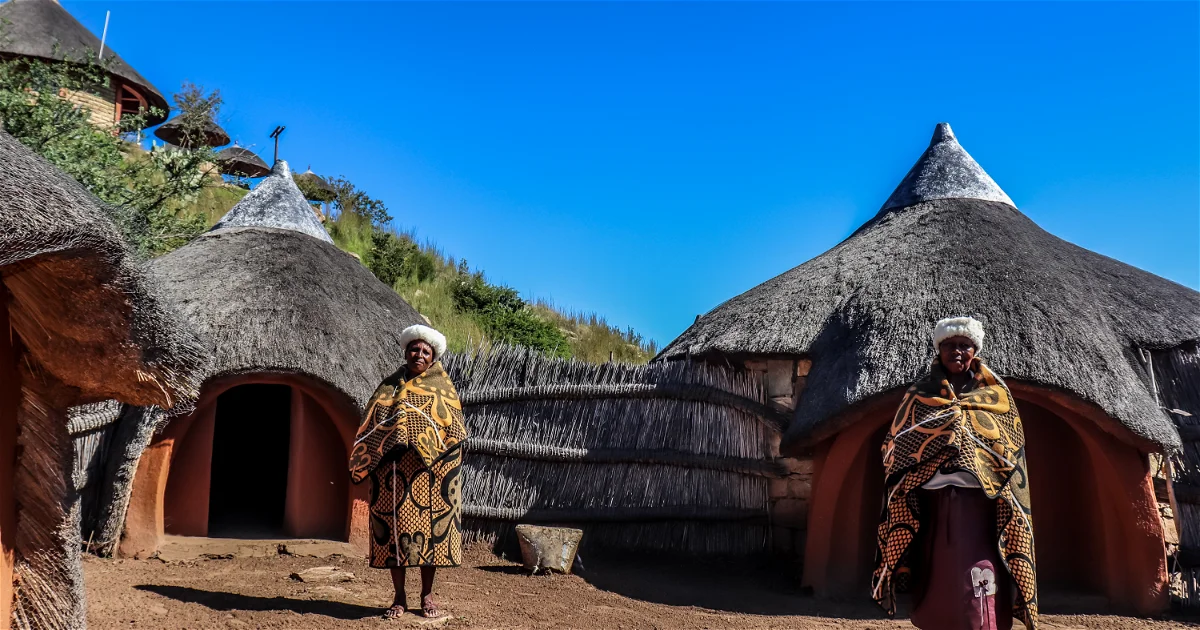
The majority of Lesotho’s population are the Basotho people. Their culture is rich in tradition and has adapted to the mountainous environment. The traditional Basotho blanket is a well-known cultural symbol worn by many.
History: Rich in Sotho culture and a legacy of resistance against foreign powers, with strong oral traditions of folk songs, proverbs, and legends. Other cultural elements include:
Arts: Contemporary artists create unique works using traditional African firing techniques and motifs from ancient San petroglyphs.
Language: Sesotho and English are the official languages.
Traditional Crafts: The Basotho are skilled in crafts like pottery and grass weaving, with the conical-shaped mokorotlo hat being a distinctive example.
Oral Traditions: Storytelling, folk tales, proverbs, and praise poetry (lithoko) are a central part of cultural life, passed down through generations.
Traditional Music: Traditional music often features instruments like the lesiba and setolotolo, and dances like the mokhibo.
Lesotho’s history is tied to the legacy of King Moshoeshoe I, who unified the various Basotho clans in the early 19th century to resist the conflicts of the Lifaqane and later, the encroaching British and Boer colonists. To preserve his kingdom, he appealed to Queen Victoria, and in 1868, Basutoland became a British protectorate. The country gained full independence as the Kingdom of Lesotho on October 4, 1966