
By Nancy Okojie
ABUJA, NIGERA- The imprisonment of Nnamdi Kanu, the leader of the proscribed Indigenous People of Biafra (IPOB), has reached a critical phase, with his legal team and the organization immediately considering their options following a recent ruling.
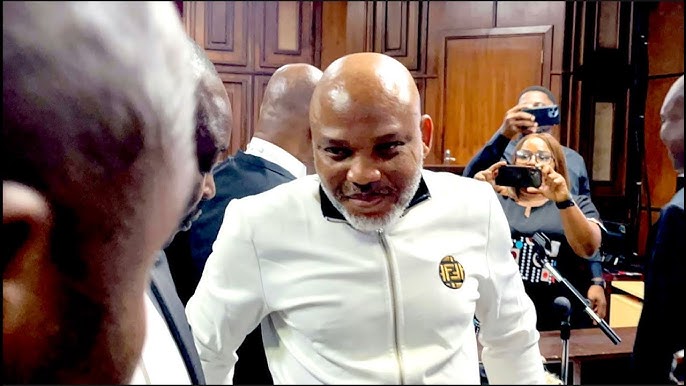
On Thursday, November 20, 2025, the Federal High Court in Abuja, presided over by Justice James Omotosho, convicted Nnamdi Kanu on all seven counts bordering on terrorism and handed down a life sentence.
READ ALSO
The charges, brought under the Terrorism (Prevention and Prohibition) Act 2022, primarily stemmed from his radio broadcasts on Radio Biafra, where he allegedly incited violence against the Nigerian state and called for the creation of an independent Republic of Biafra.
Kanu was sentenced to life imprisonment on counts 1, 2, 3, 4, and 5, and concurrent sentences of 20 and 5 years on counts 6 and 7. The judge stated that the life sentence was “sufficient punishment and merciful in the circumstances.”
Kanu has been in the custody of the Department of State Services (DSS) since his controversial rearrest in Kenya in June 2021. Following the conviction, he has reportedly been transferred to a correctional facility, with unverified reports suggesting Sokoto prison.
Kanu’s legal team and IPOB have immediately rejected the verdict and are pursuing two main options:
The Legal Appeal Process
Kanu’s lead counsel, Aloy Ejimakor, immediately indicated plans to appeal the judgment, calling it a “tragic miscarriage of justice” and reiterating claims that the trial was politically motivated.
The case is now set to move to the Court of Appeal and, ultimately, could go to the Supreme Court of Nigeria. Legal experts predict this process could take several years.
The legal team will likely continue to challenge the jurisdiction of the court and argue the validity of the charges, especially concerning the alleged extraordinary rendition of Kanu from Kenya, an issue that had previously led to a favorable ruling for him at the Appeal Court (a ruling later overturned by the Supreme Court).
Commitment to Peaceful Advocacy
Following the conviction, IPOB’s spokesperson, Emma Powerful, issued a statement condemning the sentence. The group, however, reaffirmed its commitment to a “peaceful advocacy” for self-determination.
IPOB stated its continued pursuit of a United Nations–supervised referendum to determine the independent state of Biafra.
This commitment to peaceful advocacy stands in contrast to the organization’s past actions and the violent enforcement of sit-at-home orders in the South-East, which were cited by the court as part of the terrorism charges.
The life sentence marks a major turning point in the prolonged legal and political saga of Nnamdi Kanu and the Biafra agitation movement.