

By BBC,
In her Soviet-era apartment block on the outskirts of eastern Kyiv, Oksana Zinkovska-Boyarska lives with daily power cuts. The lift to her eighth-floor apartment often stops, the lights go out and sometimes the pumps maintaining pressure in the gas central heating fail.
She has a big rechargeable battery pack to keep appliances going, but it costs €2,000 (£1,770) and it only lasts so long. Her husband Ievgen, a lawyer, often has to work by torchlight. Their two-year-old daughter Katia plays by candlelight too.
Amid air raids and cold darkness, Oksana says she and Ievgen worry constantly for Katia. “I can’t describe with words the animal fear when you take your child to the shelter during the explosions.
READ ALSO
“I have never felt anything like that in my life and I wouldn’t want anyone to feel anything like that. The thought that she might be scared because there’s no light – this is terrible.”
All across Ukraine, families are bracing themselves for even tougher times ahead – a long, cold winter in which Russian President Vladimir Putin attempts to finish off his invasion by striking Ukraine’s power supplies and networks.
Just last weekend, a massive drone and missile strike left much of the country for a time without power. Ukrainians are now enduring regular power cuts of up to 16 hours a day.
In winter, temperatures in Ukraine can plummet as low as -20C. One senior government figure told me they expect the next few months to be brutal.
“I think it will be the worst winter of our history,” says the official. “Russia will destroy our energy, our infrastructure, our heating. All state institutions should be prepared for the worst scenario.”
Maxim Timchenko, the chief executive of DTEK, a large private energy company in Ukraine, says: “Based on the intensity of attacks for the past two months, it is clear Russia is aiming for the complete destruction of Ukraine’s energy system.”
Insomnia, missiles and shifting morale
Walk the streets of Kyiv and you’ll pass a sea of tired faces – people’s eyes are red from a lack of sleep, their rest broken by the air raid sirens.
“I am tired of not sleeping enough,” says Yana Kolomiets, 31, a casting director from Odesa. “But… people who fight on the front line are tired [too].”
A recent scientific study suggested that people are three times more likely to suffer from insomnia in Ukraine than in countries at peace.
It tracked the sleep patterns of around 100 Ukrainians over six months, and found the insomnia persisted even on quiet nights. (The research was published by Texty, a data journalism website based in Ukraine.)
There have not been many quiet nights. Russia launched vast numbers of ballistic missiles at Ukraine in October – some 268 in all, the highest monthly total since the full-scale invasion, according to analysis published by the Oboz news site. The same month Russia launched 5,298 Shahed and other bomber drones.
Diplomats suggest there is a geographic focus to Russia’s tactics, their strikes deliberately targeting gas and electricity transmission networks in eastern Ukraine, rather than power stations in the west of the country.
“They are trying to cut Ukraine in two in terms of energy,” one European envoy says. “They want anywhere east of the river Dnipro to be cold this winter.”
The aim, one government source told me, is to “instigate an insurrection, so that people go against the government in Kyiv… they are trying to destroy social cohesion.”
So concerned is the United Nations Office for the Coordination of Humanitarian Affairs it has already issued a formal warning, saying “the approaching winter poses new risks for Ukrainians… as intensified attacks on energy networks undermine efforts to maintain warmth in homes, schools and health centres”.
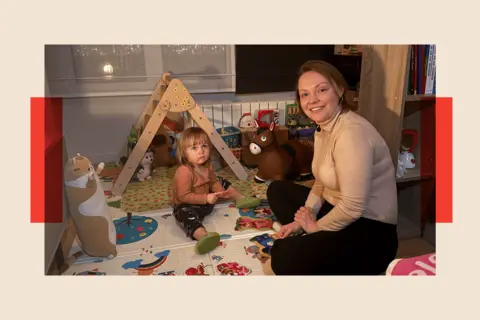 “We can hold on for as long as the front needs it,” says Oksana
Uncertainty over the outcome of the various diplomatic initiatives hasn’t helped, either. And yet opinion polls suggest people in Ukraine may in fact be more hopeful, not less.
Research by the Kyiv International Institute of Sociology, a pollster, suggested that in October 56% of 1,008 Ukrainians interviewed felt optimistic about the country’s future, up from 43% in May.
Sasha, a Kyiv-based financier, explains that Ukrainian morale is volatile, swinging wildly between optimism and pessimism.
“If people talk about an end to the war, they feel hopeful,” he says. “But then when the talks fail, they despair.” Oksana, though, is pragmatic: she says that for all the fears for her daughter, they have no choice but to endure it.
“I always think it is much worse at the front line,” she adds. “There are boys and girls on the front line who suffer much, much more. “I understand my child should not be raised in these conditions, because it is not normal in the civilised world. But we can hold on for as long as the front needs it.”