By Gbenga Oresanya,
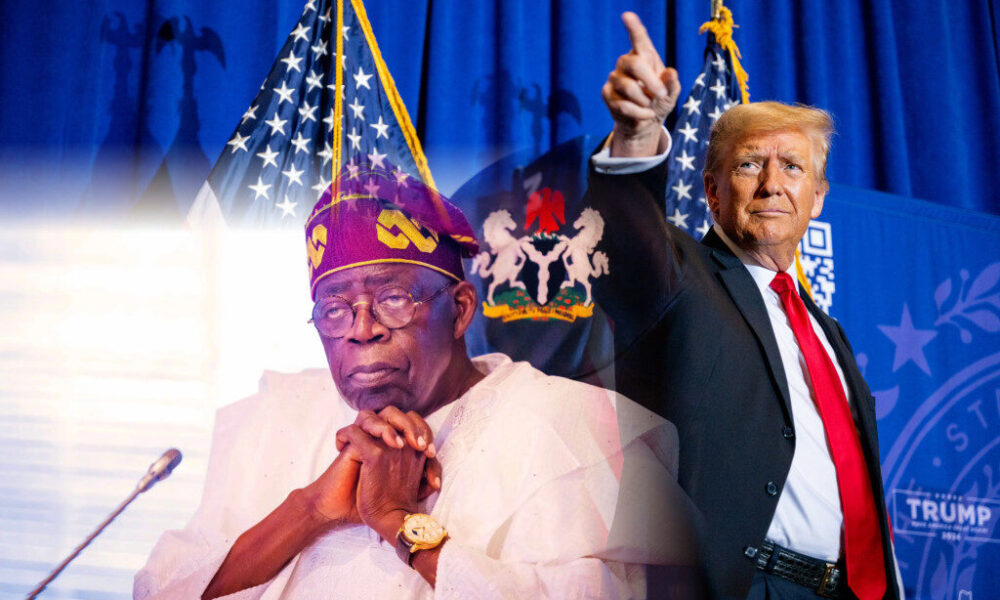
United States President Donald Trump issued a stern warning to Nigeria on Saturday, November 1, 2025, threatening to deploy U.S. military forces and immediately halt all aid if the Nigerian government fails to stop what he described as the “mass slaughter” and persecution of Christians in the country.
Trump had, on Friday, said that Christians in Nigeria are facing an “existential threat,” calling on American lawmakers to investigate “mass slaughter”.
In fact, named Nigeria a “country of particular concern” – a State Department designation for nations “engaged in severe violations of religious freedom.”
READ ALSO
The President’s Directives
President Trump made his strong statement in a post on his social media platform, Truth Social, one day after officially designating Nigeria as a “Country of Particular Concern” (CPC) for allegedly failing to protect religious freedom.
Trump warned that the U.S. “may very well go into that now disgraced country, ‘guns-a-blazing,’ to completely wipe out the Islamic Terrorists who are committing these horrible atrocities.”
He stated that the U.S. “will immediately stop all aid and assistance to Nigeria” if the killings of Christians continue.
The President announced, “I am hereby instructing our Department of War to prepare for possible action.” He warned that any potential U.S. strike would be “fast, vicious, and sweet.”
Trump posted on his ‘X’ handle that Nigeria stands firmly as a democracy governed by constitutional guarantees of religious liberty. Since 2023, our administration has maintained an open and active engagement with Christian and Muslim leaders alike and continues to address security challenges.
He claimed that “Christianity is facing an existential threat in Nigeria,” and blamed “radical Islamists” for the violence.
Nigerian Government’s Response
Nigeria’s President, Bola Ahmed Tinubu, immediately pushed back on the U.S. designation and the characterization of the country as religiously intolerant.
President Tinubu issued a statement arguing that the designation “does not reflect our national reality” and fails to acknowledge the government’s efforts to safeguard religious freedom.
He stated, “Religious freedom and tolerance have been a core tenet of our collective identity and shall always remain so. Nigeria opposes religious persecution and does not encourage it.”
Nigeria’s Ministry of Foreign Affairs reiterated the government’s commitment to defending citizens of all faiths, stating that Nigeria must “celebrate the diversity that is our greatest strength.”
Nigeria, Africa’s most populous nation, is roughly split between a predominantly Muslim North and a largely Christian South. The country has been grappling with severe, multi-faceted security challenges:
Groups like Boko Haram and the Islamic State West Africa Province (ISWAP) primarily operate in the North-East, targeting both Christians and Muslims.
Violence between largely Muslim nomadic herders and largely Christian settled farmers over dwindling resources has devastated central Nigerian states.
While Christians have been targeted, security analysts and international reports often note that the majority of victims in the northern violence are Muslims. Attacks are frequently driven by complex motives, including land disputes, criminality (banditry/kidnapping for ransom), and ethnic rivalries, often intersecting with religious identity.
The U.S. placed Nigeria on the CPC list for the first time during the previous Trump administration in 2020 but was removed in 2021. The current re-designation and the ensuing threat of military intervention mark a significant escalation in diplomatic pressure between the two nations.